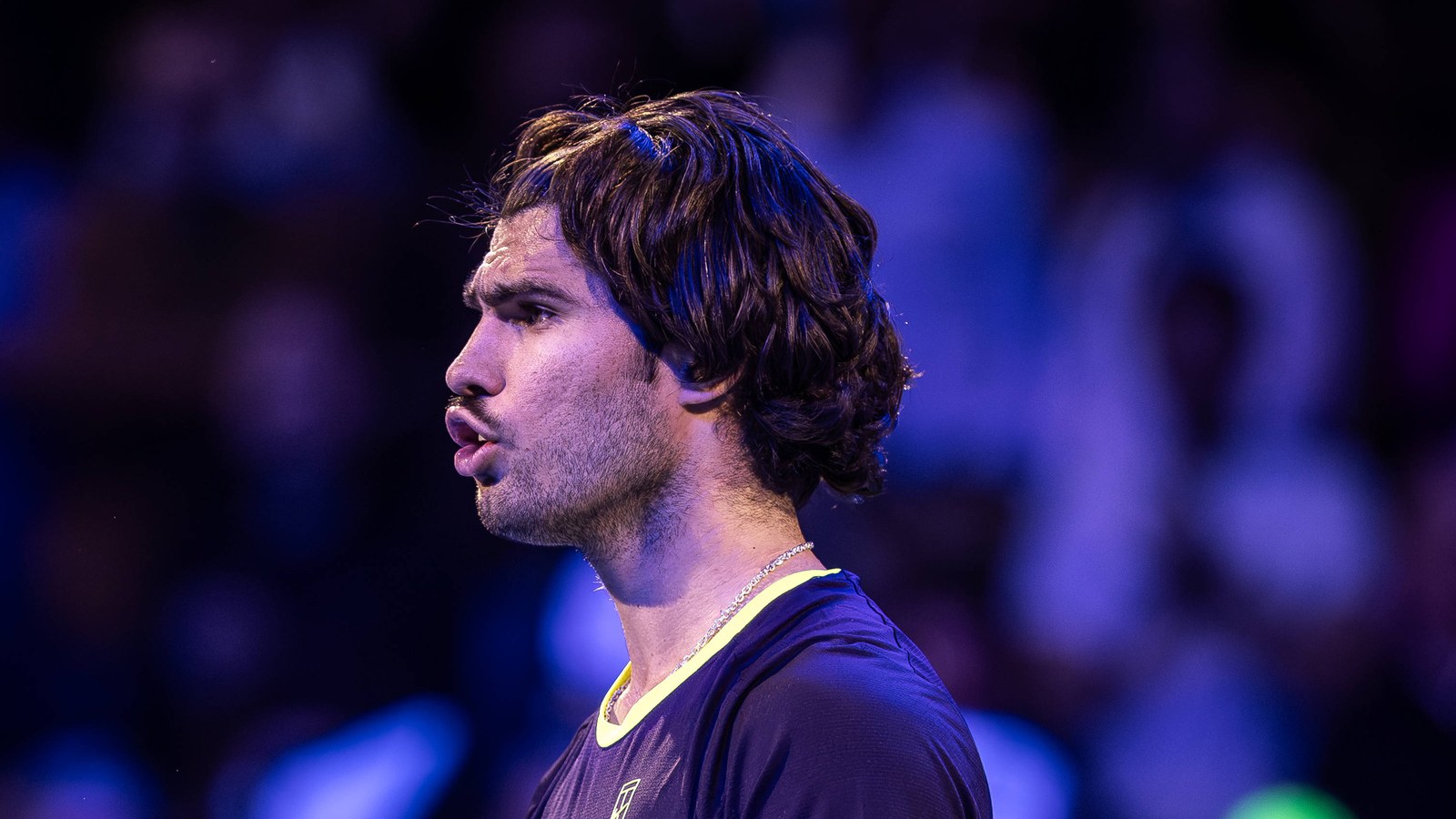
Carlos Alcaraz goes into Saturday’s ATP Finals semi-final against Ben Shelton (not before 2.30pm in Turin, 1.30pm UK) unbeaten in three matches, but still not saying exactly what is wrong with him. On Friday, a day after an MRI that put his week in doubt, he beat Flavio Cobolli 6-4 6-1 and then declined to give a diagnosis.
“Obviously I’m not going to say it here,” Alcaraz told reporters in Spanish, as reported by Tennis Majors. “I’ve seen so many things, that I’m going to retire, that I’m not, that I’m going to play, that I’m not. Well, I’ll let you choose the diagnosis.”
A test match, by his own account
Alcaraz had already won his group, so the Cobolli match counted for nothing in the standings. He treated it as a fitness test and said so. “We tried not to go crazy, not to go for the balls I normally go for, not to push myself to the maximum physically, and to be more aggressive than usual, to hit harder than usual,” he said.
He did not pretend there was no danger. “Playing a match this demanding, there is always a risk of getting hurt. I won’t lie to you,” he said, adding that he would see how his body reacted overnight. He also changed his routine, warming up shortly before the match and going straight on court, which he said had gone well enough to try again.
On Shelton, he was full of respect, calling the American “one of the most difficult challenges we have on tennis right now”.
Henman: “a little bit of the walking wounded”
Tim Henman watched the same build-up with more concern. Commentating on Sky Sports Tennis before the Cobolli match, he noted the strapping on the hamstring that had been scanned, plus taping on Alcaraz’s wrist and his other knee.
“That’s got some serious support and it’ll be interesting to see how that reacts when he gets into the match,” Henman said, as quoted by Tennis365. “Then you add to that the taping on the wrist and the taping on the other knee, this is a little bit of the walking wounded.”
He also watched Alcaraz practise and said the Spaniard started cautiously, that the footwork did not look particularly sharp, and that he was “slightly concerned because there was a lot of head shaking going on”, although he called the return to the practice court “a very positive sign”.
Henman had already doubted earlier in the week that a hamstring problem could clear up quickly, as Pundit Feed reported on Thursday. Friday’s scoreline answered part of that question, but not all of it.
Reading the two views
Alcaraz and Henman are not really contradicting each other. Alcaraz admits there is a risk and says he deliberately held back. Henman saw a player who was strapped up and careful, and drew the obvious conclusion that this was not a fully fit Alcaraz.
The difference is in what follows. Alcaraz’s answer suggests he thinks he can win at reduced intensity by shortening the points, playing aggressively and taking the ball early instead of chasing everything. That worked against Cobolli, who was already out of the tournament. Shelton is a different problem: a big server who rushes opponents and who beat Alcaraz in the US Open quarter-finals this year, before Alcaraz won their Paris Masters final.
Shelton’s game is the kind that punishes a player who cannot chase down every ball. If Alcaraz really is going for fewer balls than normal, Shelton’s serve and forehand will test that plan straight away.
Why the secrecy matters
Keeping a diagnosis private during a tournament is not unusual, and Alcaraz was open about why: he is tired of the speculation. But it also leaves the semi-final as the only real evidence. If he moves freely in the first few games, Henman’s worries will fade. If he starts shortening points even more and avoiding the stretch, the strapping will become the story again.
There is a further subplot. Juan Carlos Ferrero, Alcaraz’s former coach, now works with Shelton, something Alcaraz admitted would feel a little strange. Few people know Alcaraz’s game better, and that knowledge is now on Shelton’s side.
Subscribe to Punditfeed on Google News for all the latest updates from the world of sports!