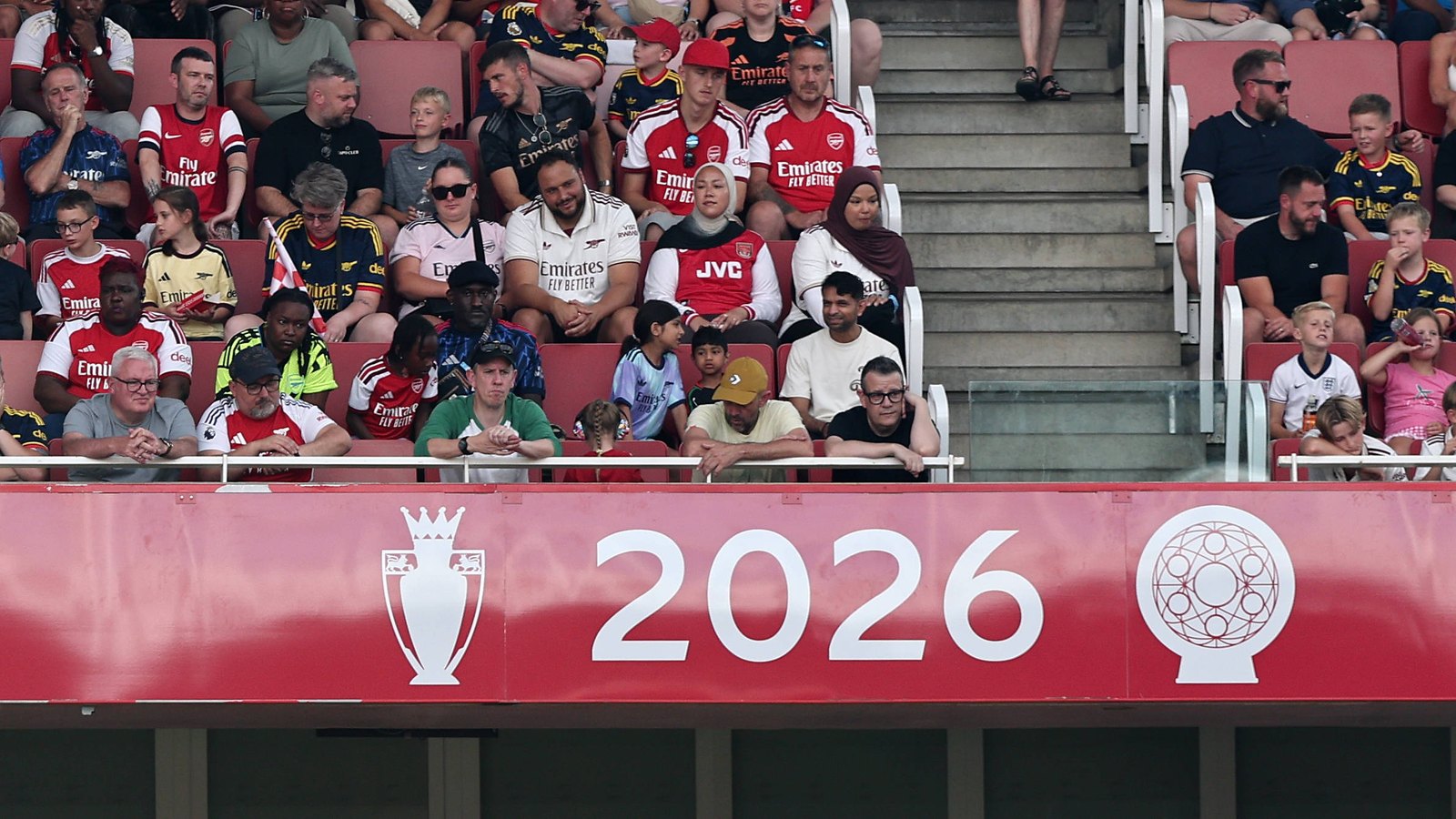
Points come first, then goal difference, then goals scored. Head-to-head records only count at the very end of the season, and only when a title, a European place or relegation depends on them. Here is how the Premier League separates teams that finish level.
With Arsenal six points clear before Sunday’s visit of Manchester City, talk of tie-breakers may sound premature. But every season produces at least one point in the table where clubs are level, and the rules that separate them are often misunderstood. They also changed in 2019/20, which is why some older explanations are now out of date.
During the season: points, goal difference, goals scored
The order of the table is set out in rules C.4 to C.7 of the Premier League Handbook. Clubs are ranked first by points. If two or more clubs have the same number of points, they are separated by goal difference, the number of league goals scored minus the number conceded. If goal difference is also level, the club that has scored more league goals goes higher.
That is the whole list while the season is in progress. If clubs are level on all three, rule C.7 says they “shall be deemed to occupy the same position in the League Table”. In other words, they are joint.
Why alphabetical order sometimes decides who is “above”
A printed table still needs one team above the other, so clubs that are joint are listed alphabetically. That is why every club starts the season in alphabetical order, with Arsenal at the top before a ball has been kicked.
It has made a visible difference before. In 2024/25, after 13 rounds, Arsenal and Chelsea both had 25 points, 26 goals scored and 14 conceded. They were officially joint second, but Arsenal were listed above Chelsea purely because of the alphabet. Earlier that same season, Brighton & Hove Albion sat above Manchester City for the same reason, until City lost at Liverpool and fell behind on goal difference.
Alphabetical order never decides anything that matters.
At the end of the season: head-to-head, then away goals
Rule C.17 applies only once all 38 rounds are complete, and only if the title, qualification for another competition or relegation cannot be decided because clubs are level on points, goal difference and goals scored. In that case, the clubs are separated as follows:
- Head-to-head points. The club with the most points from the league matches between the clubs concerned finishes higher (rule C.17.1).
- Away goals in those matches. If head-to-head points are level, the club that scored more goals as the visiting side in those games finishes higher (rule C.17.2).
- A play-off. If two clubs still cannot be separated, there is a play-off at a neutral ground, with the format, timing and venue decided by the Premier League Board (rule C.17.3).
For tied positions that decide nothing, such as two clubs level in mid-table, the clubs simply share the position.
What changed in 2019/20
Before the 2019/20 season, clubs level on points, goal difference and goals scored in a title, European or relegation battle went straight to a play-off. The head-to-head and away-goals steps were added that summer, which makes a play-off much less likely, because it now needs those clubs to be level on five separate measures.
The Premier League has never needed one. There have been seasons where it was mathematically possible for two clubs to finish with identical records, but their results always diverged before the end.
How close has it come?
The most striking early-season example came when Chelsea and Liverpool recorded identical results in each of their first five matches, in the same order. Both had 13 points, a goal difference of +11 and 12 goals scored, a first in the history of the English top flight. Chelsea were listed first, alphabetically.
Even then, a play-off was never realistic. With 33 games still to play, identical records all the way to May were close to impossible.
What it means now
For the title race this season, goal difference is the tie-breaker that is most likely to matter, simply because it comes first. Head-to-head results, including Sunday’s game at the Emirates and the return fixture, only come into play if Arsenal and City were to finish level on points, goal difference and goals scored.
The same rules apply at the other end of the table and in the race for Europe. For how the separate Champions League league phase ranks its clubs, see our guide to the Champions League standings. Arsenal’s own midweek game brought a refereeing debate too, as Alan Shearer and Mark Clattenburg argued that the champions got away with a Gyokeres handball against Dortmund.
Subscribe to Punditfeed on Google News for all the latest updates from the world of sports!