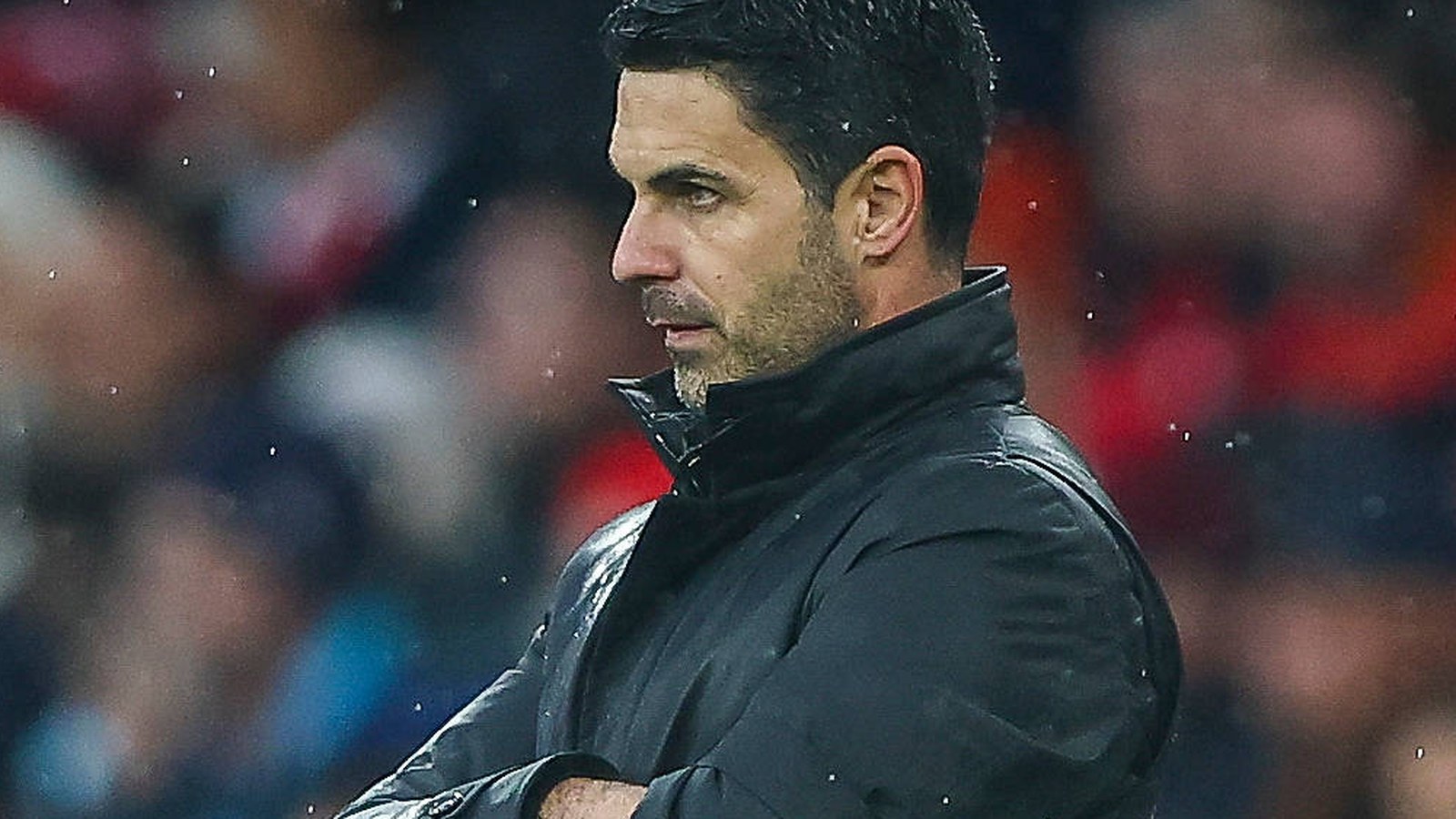
Mikel Arteta has been collecting images of rival managers stepping outside their technical area, and Jonathan Wilson thinks he knows why. In his Guardian column, Wilson sets out two readings of the Arsenal manager’s “massive storage of images” and says that one of them could prove dangerous for the club.
What Arteta said
After Arsenal’s 2-0 win over Everton last Saturday, Arteta received his second booking of the season for leaving his technical area. He did not dispute the booking, but he argued that others get away with far more. “There are managers who have the record in the league, 36 times in 10 minutes [they] leave the touchline – no yellows,” he said, adding: “I am clipping all of that … so if somebody comes to me I can say: ‘I am not in the record yet.'”
The word “dossier” was applied afterwards by the press. Arteta’s own phrase was “a massive storage of images”. Wilson notes that the former referee Graham Scott counted 44 occasions on which Arteta left the technical area before he was booked.
Wilson’s two readings
The first reading is that Arteta means it. In Wilson’s telling that makes him a “ludicrous Pooterish figure”, a neighbourhood-watch curtain-twitcher with a persecution complex, counting other people’s misdemeanours while he is fined for his own. English football, Wilson writes, treats the word “dossier” as inherently risible, and he says that was true when Don Revie compiled scouting reports on opponents.
The second reading is that it is deliberate. Wilson suggests Arteta may be trying to persuade his own supporters that everybody is against Arsenal, to build a siege mentality. He points to online fans who remain convinced that referees have been working against the club for years, and to the defence some offered of Max Dowman after the 16-year-old’s red card at Fleetwood on Tuesday, even though Arteta himself appeared furious with the teenager.
“Arteta, clearly, is not at that level, at least not yet, but if his dossier is part of a deliberate strategy it is a dangerous one,” Wilson writes, placing him below Alex Ferguson and José Mourinho in the art of mind games.
The history Wilson reaches for
Wilson spends much of the column on the long tradition of psychological warfare in the game. He recalls that before the 1939 FA Cup final the Wolves manager Major Frank Buckley was widely believed to have given his players “animal secretions”, a claim Wilson says was almost certainly vitamins, and that Wolves still lost 4-1 to Portsmouth. He also recalls Helenio Herrera distributing 100,000 leaflets before Inter’s 1965 European Cup semi-final second leg against Liverpool, an episode he says stirred up the San Siro crowd.
His point is that mind games are often harmless publicity stunts, but that attempts at psychological manipulation can take on a darker aspect. Ferguson, he writes, was a master of the art, while Mourinho openly acknowledged that the next game begins in the post-match press conference for the previous one, and often crossed the line of professional decency.
The counter-view
Arteta’s own position is simple and has an internal logic: if the rules are applied unevenly, he wants the evidence. A manager who is booked for leaving the technical area is entitled to ask whether others are held to the same standard, and nothing in that argument requires a conspiracy.
What Wilson objects to is the framing. A manager who has collected clips to defend himself is one thing; a club that tells its supporters that officials are against it is another. Wilson argues the second is “not conducive to winning league titles”. Our earlier piece on Jamie Carragher’s view that Arsenal are still “the team to stop” covered a pundit judging Arsenal purely on what they do on the pitch.
Why it matters
If the dossier is a throwaway line, it will be forgotten after the next booking. If it becomes a theme, it hands every rival, and every neutral, an easy narrative about a club looking for someone else to blame. Wilson’s column is a warning that a mood of insecurity, of being convinced everything is against you, does not help a team win titles.
The test comes quickly. The next time Arteta leaves his technical area, there will be more cameras on him than on any manager in the league, and not only his own.
Wilson’s full column is on the Guardian.
Subscribe to Punditfeed on Google News for all the latest updates from the world of sports!